. Written by the SOPFlow editorial team from official Guru documentation and SOPFlow implementation. The packet below is an original evaluation aid, not a completed Guru trial, independent review or customer outcome.
Choose for the knowledge and work your team needs
Consider Guru when people need cited answers across connected company information, with knowledge ownership and quality controls. Consider SOPFlow when a team needs to capture a supported browser task, maintain a procedure with an owner and review, train from it and record recurring work. Both can support dependable operating knowledge. Evaluate the specific workflow rather than treating knowledge retrieval and procedure execution as interchangeable.
If your team needs both, decide where the authoritative instructions and actual task records live, then test the links between them. This page does not describe a native Guru–SOPFlow connector or establish parity with enterprise search infrastructure.
Inspect the source, its trust decision and the task evidence
| Need | Guru documentation or check | SOPFlow check |
|---|---|---|
| Find an instruction | Knowledge Agents search connected information and return answers with citations. | Open the applicable published procedure and inspect its maintaining owner and version reference. |
| Keep knowledge current | Cards have assigned verifiers; Knowledge Agents can automate verification with human oversight. | Create a draft, follow the review policy and publish accepted instructions. Inspect the decision and the version a reader uses. |
| Choose reader access | Source access can use Guru Groups or inherited permissions for supported connectors. | Check actual procedure and workspace permissions with the intended reader. A written role or org-chart label alone does not grant access. |
| Know whether work happened | For a completion answer, inspect the cited task data and its scope. | Use a procedure run for the particular occurrence and inspect responses, required checks and any configured sign-off. |
Test the configured permissions and verification rules
Guru's source documentation describes two access models: manually assigned Guru Groups and inherited source permissions where supported. Record which model the proposed connector uses, then test with approved sample readers. Do not assume a connector's behavior from a general permission-aware claim. In either product, check the actual content, reader and access-change behavior needed by your organization.
A verification status is a trust decision about content. Inspect who or what made it, the rules, source scope and date. Decide which instruction changes require an explicit named review under your procedure policy. Do not use a content badge alone as authorization for a business action or proof that a task finished.
Use one original procedure and five answer checks
OPS-K01 is a fictional administrative request handoff. Use permitted test content and participants. The example does not authorize a purchase, customer message or account change. Its current reference and expected results let the evaluator judge whether an answer is supported before trying a product.
- Current reference
- OPS-K01 · revision B · Fictional example
- Maintaining owner
- Operations coordinator
- Start condition
- A sample request has a contact reference and defined scope.
- Completion condition
- The named receiver records receipt of the next action.
- Change from A
- Earlier revision A named a receiver; B adds explicit receipt before closure.
- Check the sample request reference, contact and scope. Leave missing information unresolved until the coordinating owner supplies it.
- Name the receiver and one concrete next action with its agreed follow-up point.
- Record the receiver's explicit receipt. If the receiver is unavailable, keep the handoff open and route the question to the operations coordinator.
- Check contact, scope, receiver, next action and receipt before recording completion. Retain the particular request record separately from these reusable instructions.
Agree the expected evidence before asking
Which OPS-K01 revision governs the current handoff?
Identify B and cite the designated current instructions; do not select A merely because an older copy is easier to find.
The receiver is unavailable. Can I close the handoff?
Explain the open handoff, coordinating owner and follow-up from the current exception. Do not invent receipt.
After an agreed instruction changes, which source now applies?
Prepare the change and expected answer first. Inspect the source reference, configured refresh/quality behavior and any stale answer; record the observed delay without assuming immediate propagation.
Can this reader retrieve a restricted test note?
Use an approved sample note and a private marker not present in the question or public packet. An unauthorized test reader must not receive its content; check the authorized reader separately.
Is request DEMO-308 complete?
The reusable procedure alone cannot establish completion. If permitted task evidence is supplied, inspect its citation, receipt and scope rather than assuming a search answer or procedure view proves the work.
For each question, record the actual answer or located instruction, cited source/version, access context and underlying task record where relevant. Both products start Not tested. The expected checks are teaching criteria, not claims that either product passed. Keep private evidence and account details in their authorized systems.
Download the sample procedure and question-set record (Markdown)
This is portable sample text and a blank evaluation record, not a native Guru template, connector or account export.
The walkthrough shows a separate prepared SOPFlow customer-handoff change review. It illustrates the review interface, not OPS-K01, a Guru verification screen or a completed two-product benchmark.
See the workflow in SOPFlow
See the reviewer, decision, and procedure together.
The review panel sits beside the procedure it concerns. This prepared example includes an approval decision and the checks the reviewer verified.
Watch the approval walkthrough · 0:40
Review a change and record approval
0:40 · Captioned walkthrough · No audio
Version 1.1 adds receiving-owner acceptance. Read the change note, instructions and unavailable-owner exception.
Edited captures of actual SOPFlow controls with fictional records. Desktop and mobile examples follow the same workflow.
Read the full walkthrough transcript
0:00 · Understand the change
Version 1.1 adds receiving-owner acceptance. Read the change note, instructions and unavailable-owner exception.
0:08 · Check the approval policy
The policy names the reviewer and requires approval independent of the submitter. The decision is still pending.
0:16 · Inspect the review snapshot
Content identity records the reviewed content. Its scope explains what the snapshot includes and what it does not verify.
0:24 · Explain the decision
Add a review note describing the acceptance check and the exception that were verified.
0:32 · Record the approval
Record approval and review the named decision. Approval and publication are separate steps; publication is not shown here.
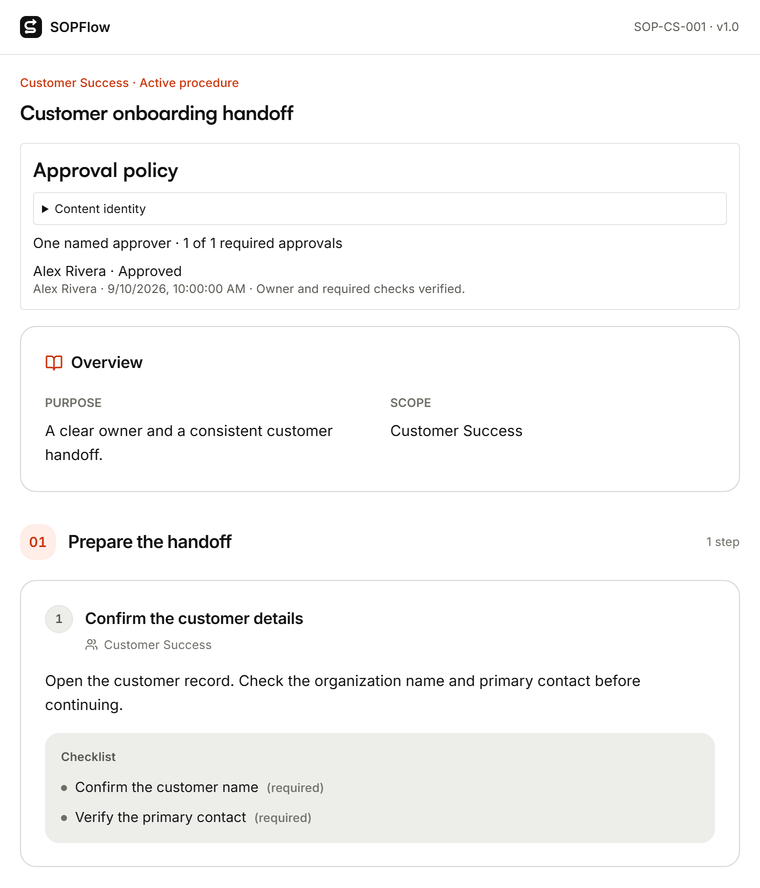

Actual SOPFlow components with prepared fictional records. These examples show the interface, not a customer result.
Compare the proposed scope and commitment
Guru's current pricing page offers a tailored platform-and-expertise package through a sales conversation. We have not obtained a quote. Confirm required sources, permission model, quality controls, usage, retention, implementation and ongoing service scope in the proposal. Compare these with SOPFlow's current workspace plans and the capabilities your actual task needs.
Guru's current pricing and package scope
Move one procedure and retain its references
Inventory the source instructions, attachments, owners, permissions, verification decisions and task evidence that must be retained. Rebuild one procedure deliberately and have the intended readers test it. Copying text does not transfer connector access, trust decisions or task history. Keep the former reference until the responsible team accepts the replacement. If both systems remain, assign one authoritative instruction owner and a clear update path instead of leaving conflicting copies.