Define the outcome and the people responsible
An employee onboarding SOP defines how a team prepares, welcomes, trains and supports a new colleague. Its checklist records who does each task, when it is needed and what shows it is complete. A welcome session, a training score and a successful practice task each provide different evidence.
This example covers a customer success coordinator learning an administrative account handoff. All names, IDs, observations and decisions are fictional teaching examples, not employee assessments or customer results. Adapt the sequence to the role and your approved people processes. This guide covers operational learning, not the full set of hiring or statutory requirements.
- Procedure
- ONB-001 · Customer success coordinator onboarding · version 1.0
- Maintaining owner
- Customer success manager
- Start condition
- Role, start arrangements, manager and required access approvals confirmed.
- Completion condition
- Manager reviews the agreed practice evidence, resolves or assigns open items and records the next supported responsibility.
- Related instructions
- HND-014 · Administrative customer handoff · version 1.2, used for the fictional practice below.
Assign a person to each responsibility
- Manager: Owns the plan, sets the practical checks and records the readiness decision.
- Access administrator: Processes authorized requests and helps the learner verify only the access needed for the role.
- Procedure owner: Maintains the approved instructions and resolves unclear steps or exceptions.
- Trainer or buddy: Demonstrates the task, observes practice and records specific feedback.
- Learner: Finds the instructions, practices, asks questions and identifies unresolved work.
Build a checklist from preparation to review
The timing is a planning example. Choose real dates, named people and support arrangements before assigning work. If a prerequisite is missing, record the item, its resolving owner and the next check. Change the plan instead of marking the task complete.
| When and task | Responsible role | Evidence or decision |
|---|---|---|
| Before arrival · prepare the plan | Manager | Role outcome, buddy, first meeting, current procedure references and review dates agreed. |
| Before practice · verify approved access | Access administrator and learner | Learner opens the permitted sample workspace. Unresolved requests have an owner; no shared credentials or unnecessary permissions are used. |
| First day · find people and instructions | Manager and learner | Learner finds current HND-014, its maintaining owner, receiving role and question channel. |
| First week · learn the assigned version | Trainer and learner | Record the version studied and explain the handoff decision. Keep reading acknowledgment or quiz results separate from observed practice. |
| First week · practice the ordinary case | Learner, observed by trainer | Demo Account 104 has confirmed contact and scope, a named receiver, a next action and explicit receipt. |
| First week · practice the exception | Learner and procedure owner | For Demo Account 105, recognize the missing contact, keep the handoff open and record resolving owner and follow-up. |
| Before independent work · review evidence | Manager | Compare both records with the agreed checks. Record what can proceed, limits, open items and further support. |
| After the first supported assignment · improve | Manager, learner and procedure owner | Discuss unclear steps, assign corrections and choose the next review. Retain the original practice and training context. |
First day: make the work and support easy to find
Show where to find the current procedure and its maintaining owner. Ask the learner to locate the receiving person and explain the expected handoff. Introduce the buddy and agree a question channel and check-in. For a remote colleague, verify the same route works from their approved setup before practice.
If access or a reviewer is unavailable
Record the blocker and the person resolving it. Assign another appropriate sample activity or reschedule the review. Do not use another person's account, bypass an approval or treat a missing prerequisite as complete. If the receiving owner cannot accept a handoff, keep it open until the documented exception is resolved.
First week: practice the ordinary path and an exception
Give the learner HND-014 version 1.2 and two fictional records. The task is to prepare and hand over an administrative account record. It does not authorize a commercial commitment or a message to a real customer. The trainer demonstrates the decision, then observes the learner using the instructions.
- Check account reference, contact reference and agreed scope against the sample source. Identify missing information before handing work over.
- Name the receiver and record one concrete next action and its agreed follow-up point.
- Ask the designated receiver to confirm receipt in the practice record. Keep unresolved work open and name who resolves it.
- Review the record together. Ask the learner to explain what they would do if the contact or receiving owner were unavailable.
Two completed fictional practice records
Demo Account 104 · ordinary path
- Participants
- Avery, learner; Morgan, trainer; Jules, receiving owner.
- Recorded work
- CONTACT-104 and scope confirmed. Next action: Jules checks the prepared kickoff brief at the next agreed practice review.
- Receipt
- Jules confirms account reference, scope and next action in the sample record.
- Observed outcome
- All ordinary-path checks are present. One practice observation does not authorize every responsibility.
Demo Account 105 · missing contact
- Initial observation
- No contact reference in the source. Avery marks the handoff pending and assigns the question to Eli, the procedure owner.
- Follow-up
- At the agreed follow-up, Eli supplies sample CONTACT-105. Avery rechecks the source; Jules accepts receipt.
- Record retained
- Initial blocker, resolving owner, correction and later receipt remain visible.
- Observed outcome
- The exception is resolved before closure. Nothing was accepted while the required reference was missing.
Review readiness with an observable result
Agree the checks before practice. A completed checklist or quiz informs the conversation; the manager still observes the task and discusses questions. Use role-relevant evidence and explain the scope of the decision.
- Find the current procedure and explain who maintains it.
- Produce the required ordinary-case evidence and identify the receiver.
- Recognize missing information and follow the exception without inventing a completed result.
- Explain the next action, open items and how to ask for help.
Fictional readiness review
- Review reference
- ONB-001 / Avery / first practice review
- Evidence inspected
- HND-014 v1.2 learning record; Demo Accounts 104 and 105 practice notes and receipt.
- Decision by Morgan, manager in this example
- Continue with one supervised administrative handoff. The checks were demonstrated in sample work; broader responsibilities remain outside this decision.
- Next support and review
- Buddy available for the first assignment; manager reviews its record before expanding responsibility.
- Learner feedback
- The original instruction did not clearly say where to record a missing-contact question. Eli owns the clarification.
Respond to feedback and procedure changes
The procedure owner reviews a correction before publishing it. If HND-014 changes from version 1.2 to 1.3 during onboarding, record the change and decide whether explanation, another practice task or a new training assignment is appropriate. Retain the earlier assignment and attempt's original content context. Do not relabel old evidence as if the learner used new instructions.
In SOPFlow, assigned training retains a procedure snapshot and version reference; the learning attempt records its result. A separate run records the particular task. Use these records alongside the manager's practical review. Product records do not automatically establish readiness for every part of a role.
The walkthrough shows prepared fictional training screens for a customer handoff: an assignment, a question and a retained result. It is separate from the plan and practice records above and does not show a real employee being assessed.
See the workflow in SOPFlow
An assigned procedure. A training record to review.
This customer success example shows assigned learning and a completed attempt against SOP-CS-001. A manager still reviews the learner’s practical handoff before deciding readiness.
Watch the onboarding walkthrough · 0:42
From assigned SOP to training record
0:42 · Captioned walkthrough · No audio
Open the assigned procedure. The version reference tells the learner which instructions this assignment covers.
Edited captures of actual SOPFlow controls with fictional records. Desktop and mobile examples follow the same workflow.
Read the full walkthrough transcript
0:00 · Find the assignment
Open the assigned procedure. The version reference tells the learner which instructions this assignment covers.
0:07 · Read the procedure
Review the current instructions and the exception: keep the handoff open when the receiving owner is unavailable.
0:14 · Check the decision
The quiz checks a practical decision from the procedure, including what to do when the ordinary path cannot continue.
0:21 · Answer and acknowledge
Select the appropriate action and acknowledge that you have read and understood this assigned version.
0:28 · Review the result
Submit the answers and review the recorded quiz result. A passing score is one input to readiness.
0:35 · Keep the context
The retained attempt shows the procedure version and result. A manager still checks practical readiness for the role.
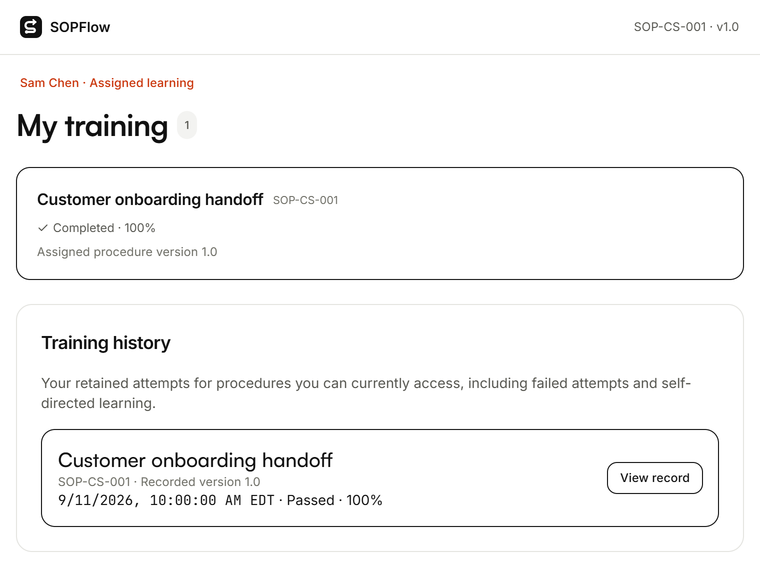

Actual SOPFlow components with prepared fictional records. These examples show the interface, not a customer result.
Maintain the plan and download the example
Review the plan after an onboarding cycle and when the role, tools or supporting instructions change. Record the question, resolving owner and next review instead of simply extending a checklist. Distinguish the company welcome, role-specific learning and individual practice records.
Use the completed example and your own blank plan
The editable Markdown file contains this example and a blank plan and review record. The shorter checklist below remains available in Word, PDF and Markdown. No example result is evidence about your own team.
Download the worked onboarding plan and blank records (Markdown)Continue with the task you need
- Evaluate SOPFlow's employee onboarding workflow
- Plan procedure changes and preserve earlier context
- Write and test the supporting procedure
- Compare SOPFlow and Trainual for training needs
Further reading: CIPD's induction factsheet introduces the purpose of induction, and the knowledge and support a new colleague needs. This plan and its fictional records are SOPFlow's original teaching example. CIPD · Induction
For a filled-in first-task procedure, see the employee onboarding SOP example and readiness record.
Example checklist for a customer success coordinator
This sample separates access, learning and readiness. The manager owns the checklist; IT owns access provisioning; the procedure owner answers process questions. Completion of reading is not the same as demonstrated readiness.
| Stage | Responsible role | Completion evidence |
|---|---|---|
| Before the first practice task | Manager and IT | Named manager, role-appropriate access approved and tested; current handoff SOP assigned. |
| Guided practice | Learner and trainer | Use Demo Account 104. Verify contact and scope, assign the receiving owner, and record a next action. |
| Exception practice | Learner | Recognize a missing contact, pause the handoff and route the question to the procedure owner. |
| Readiness review | Manager | Inspect the fictional handoff record, discuss unresolved questions and record the decision and any additional practice. |
Before using the example
- Keep passwords and private employee information out of the checklist and screenshots.
- If a procedure changes, the owner decides whether the learner needs a new assignment or a short explanation. Preserve the earlier training record.
- Choose your review dates and readiness criteria before assigning the checklist; the example is not a universal onboarding schedule.
Onboarding checklist
Free downloads. Edit the Word file in Word or import it into Google Docs.
Continue with a related task
Want to know why we built SOPFlow? Read the founder’s story.